
Does Your AI System Have Transparency Obligations?
The EU AI Act establishes specific transparency obligations for certain Artificial Intelligence systems, including systems that interact directly with individuals and certain systems that generate or manipulate synthetic content.
The applicable obligations depend on the type of system, its intended purpose, how it is used, and the organisation’s role as a provider or deployer.
Aicertia identifies the applicable requirements and assesses whether the necessary transparency mechanisms have been properly implemented and documented.
What Types of Systems Do We Assess?
- Chatbots and Virtual Assistants — AI systems that interact directly with customers, users, or employees.
- Avatars and Virtual Agents — Systems that digitally represent a person or entity through AI-generated voice, images, or video.
- AI-Generated Content — Text, images, audio, or video generated or manipulated using Artificial Intelligence systems.
- Deepfakes and Synthetic Content — Artificial or manipulated content subject to specific disclosure or identification requirements.
- Other Article 50 Use Cases — Systems or content subject to specific transparency requirements depending on their nature and use.
What Does the Aicertia Seal Attest To?
- The Aicertia Generative AI Transparency Seal is a private assessment mark awarded for the specific system and scope assessed.It indicates that, at the time of the assessment, the system met the transparency criteria defined by Aicertia within the scope reviewed.
- The Aicertia Seal does not constitute an official European Union certification, a formal conformity assessment, or regulatory approval under the EU AI Act.
What Do We Assess?
- Scope and Organisational Role — We identify the AI system, its intended purpose, users, affected persons, and the organisation’s role to determine which transparency obligations may apply.
- Transparency in User Interactions — We assess whether individuals are appropriately informed when they interact directly with an Artificial Intelligence system, where such an obligation applies.
- Identification of AI-Generated or Manipulated Content — We review the mechanisms used to identify, label, or disclose synthetic content generated or manipulated using AI.
- Specific Article 50 Requirements — Where applicable, we assess transparency mechanisms related to deepfakes, content on matters of public interest, emotion recognition, biometric categorisation, and other regulated use cases.
- Timing, Clarity and Accessibility of Disclosures — We review whether information is provided clearly, visibly, understandably, and at the appropriate point of interaction or exposure.
- Evidence and Traceability — We review policies, procedures, screenshots, configurations, records, and other evidence that can demonstrate the implementation of transparency mechanisms.
- Gap Analysis — We identify missing, incomplete, or insufficiently documented mechanisms and classify findings according to their priority and regulatory impact.
Assessment Outcome
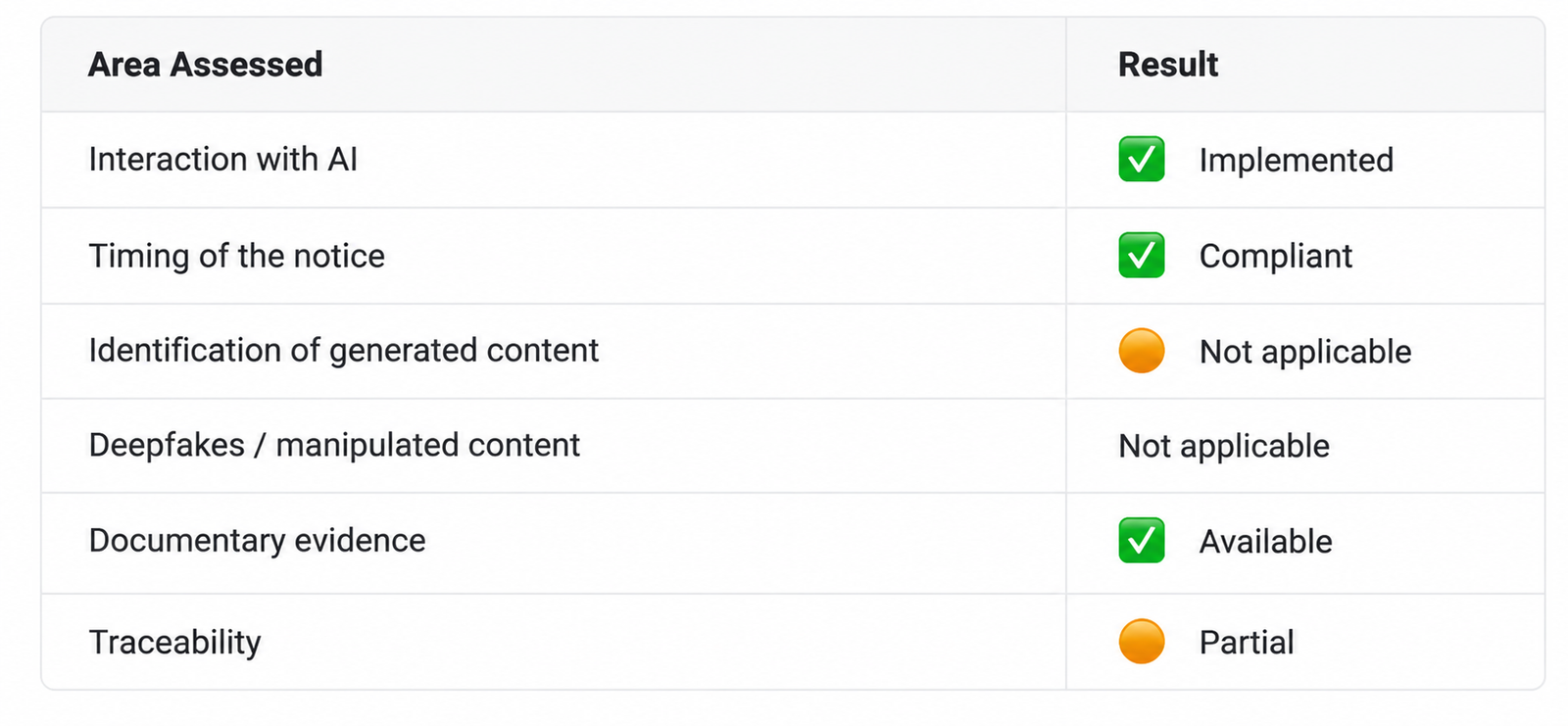
The assessment outcome makes it easy to identify which requirements have been properly implemented, which require improvement, and which actions should be prioritised.
Deliverables
1. AI Transparency Assessment Report — A structured document covering the assessed scope, requirements analysed, mechanisms reviewed, available evidence, findings, and recommendations.
2. Gap Analysis and Action Plan — A prioritised record of identified gaps and recommended actions to address missing or insufficient transparency mechanisms.
3. Aicertia Generative AI Transparency Seal — When the assessment criteria defined for the reviewed scope are met, Aicertia may award its private transparency seal.
4. Digital Verification Record — A record linked to the assessment that allows the validity, scope, status, and issuance date of the seal to be verified.
Pricing
From €990
For one clearly defined AI system or use case.
We also offer tailored assessments for organisations with multiple AI systems, chatbots, avatars, platforms, or generative AI use cases.
Strengthen Transparency Across Your AI Systems
Assess how your organisation implements AI transparency requirements and identify the measures needed to align your systems and use cases with the applicable provisions of the EU AI Act.
Join Our Community
Enter your email address to register to our newsletter subscription delivered on regular basis!