
EU AI Act Expert Certification
Option 1: Authority and Auditing Focus
Achieve the highest level of competence in EU AI Act auditing and compliance with Aicertia’s most authoritative and institutionally recognized credential.
100% Online
Competency-Focused
Online-Verifiable Certificate
From €995

Registration Form + Payment
Secure payment via PayPal or credit/debit card.

Objective
The primary objective of the EU AI Act Expert credential is to formally certify the highest level of technical, legal, and operational competence required to lead algorithmic governance, design regulatory compliance frameworks, and conduct independent conformity audits of Artificial Intelligence systems, with particular emphasis on High-Risk systems and prohibited AI practices under the European Union’s legal framework.
Key Competencies Validated by This Credential
This certification assesses and confirms that the professional is fully qualified to:
Audit Conformity: Plan and conduct independent audits and inspections of AI systems, issuing authoritative reports on their level of regulatory and technical compliance.
Design Risk Management Systems: Structure and implement the mandatory risk management systems required under the EU AI Act for High-Risk AI systems.
Ensure Data Governance: Oversee training, validation, and testing datasets to ensure compliance with the Regulation’s strict requirements concerning quality, bias, representativeness, and traceability.
Act as an Institutional Liaison: Serve as a trusted senior representative before AI supervisory authorities, Notified Bodies, and external auditors.
Lead Ethics and Compliance Committees: Direct the organization’s AI strategy, ensuring that technological innovation remains aligned with legal certainty, safety, and fundamental rights.
Who Is This Certification For?
Aicertia’s EU AI Act Expert credential is intended exclusively for senior professionals, executives, and assessors who must assume the highest levels of legal, technical, or supervisory responsibility in the governance of Artificial Intelligence.
As the highest distinction within the certification framework, it is designed for professionals who need to formally and verifiably demonstrate their competence in auditing and senior-level regulatory risk management.
The certification is aimed at four main professional groups:
1. Audit and Regulatory Compliance
Information Systems and Process Auditors: Internal or external professionals responsible for conducting independent audits and issuing authoritative conformity reports under the European Union AI Act.
Compliance Officers and Compliance Directors: Professionals responsible for designing, implementing, and overseeing the organization’s legal and operational risk framework for the deployment of algorithmic systems.
2. Executive and Technology Leadership — C-Level
Chief AI Officers (CAIOs) and Chief Data Officers (CDOs): Emerging executive roles responsible for aligning organizational innovation with European legal and regulatory requirements.
Chief Technology Officers (CTOs) and Innovation Directors: Technical leaders responsible for ensuring that model architecture—including training data, traceability, and bias controls—complies with the Regulation from the design stage through a compliance-by-design approach.
3. Specialized Legal Advisory
Technology Lawyers and Legal Counsel: Legal advisers working within major corporations or law firms who require an authoritative certification to validate their expertise in litigation, complex contracts, and regulatory inspections.
4. Risk Management, Privacy, and Security
Corporate Risk Managers: Professionals responsible for assessing the financial, operational, and reputational impact of AI systems used or marketed by the organization.
Data Protection Officers (DPOs) and Chief Information Security Officers (CISOs): Privacy and security specialists seeking to expand and consolidate their expertise in the European Union’s new AI regulatory framework.
Level
- Certification Level: Highest Professional Rank / Senior Executive — Expert Level.
- Admission Requirements: To preserve the rigor, exclusivity, and international prestige of this elite credential, candidates are expected to possess a solid background in business strategy, technology law, regulatory compliance, or systems infrastructure. Prior experience in C-level positions, senior consulting, legal functions, or corporate risk management is strongly recommended.
- Assessment Format: 100% Online and Flexible. The entire process is managed through Aicertia’s Virtual Campus. Once enrolled, candidates have a flexible 12-month period to complete the expert-level examination and defend their practical AI governance assessment according to their executive availability.
- Recommended Candidate Profile: Chief AI Officers (CAIOs), Compliance Officers, corporate legal advisers, Chief Information Security Officers (CISOs), systems auditors, and partners at strategic consulting firms specializing in regulatory protection and the ethical deployment of Artificial Intelligence.
Certification Syllabus
Module 1: Legal Architecture and Liability Across the AI Value Chain
The EU Governance Ecosystem: Structure of the European AI Office, powers of national supervisory authorities, and the penalty regime, including the calculation of fines based on global annual turnover.
Boundaries of the Scope of Application: Technical exclusion criteria for purely open-source systems, environments used exclusively for research and development, and national security applications.
Legal Roles Matrix: Critical breakdown of the obligations applicable to Providers, Deployers, Importers, and Distributors.
Managing Extraterritorial Impact: Application of the Regulation to models developed outside the European Union whose outputs are used, or whose users are located, within the EU.
Module 2: Advanced Risk Classification and General-Purpose AI Models (GPAI)
Auditing Prohibited AI Systems — Unacceptable Risk: Analysis of cases involving bias in social scoring, biometric categorization, subliminal manipulation techniques, and emotion recognition in the workplace.
High-Risk Taxonomy: Classification criteria based on Annex III and AI systems integrated as safety components of regulated products.
Foundation Models and GPAI Models with Systemic Risk: Computing-capacity thresholds measured in FLOPs, transparency obligations for open-source models, and systemic risk-mitigation requirements.
Transparency Obligations for Limited-Risk Systems: Watermarking protocols, deepfake detection, and automated labelling of synthetic text.
Block II: Technical Auditing and Conformity Assessment
Module 3: Data Engineering, Robustness, and Technical Requirements
Data Governance and Bias Mitigation: Auditing training, validation, and testing datasets. Assessment of representativeness, quality, and safeguards against algorithmic bias.
System Technical Documentation: Structure and maintenance of the Technical Documentation File required before an AI system is placed on the market.
Traceability and Event Logging: Design of automated logging capabilities to ensure the auditability of the AI system throughout its lifecycle.
Human Oversight Interfaces: Control mechanisms, including Human-in-the-Loop and Human-on-the-Loop approaches, and the design of emergency shutdown systems or kill switches.
Technical Robustness and AI Cybersecurity: Accuracy metrics, resilience against adversarial attacks, data poisoning, and overall system robustness.
Module 4: Impact Assessment and Official Certification — CE Marking
FRIA Methodology — Fundamental Rights Impact Assessment: Practical design and implementation of assessments concerning the impact of AI systems on users’ fundamental rights.
Conformity Assessment Procedures: Determining when internal control procedures apply and when the involvement of an external Notified Body is mandatory.
CE-Marking and Centralized Registration Process: Preparation of the EU Declaration of Conformity and registration of the system in the EU database for High-Risk AI systems.
Post-Market Monitoring: Design of continuous monitoring plans, deviation analysis, and protocols for reporting serious incidents.
Block III: Practical Implementation and International Standards
Module 5: Artificial Intelligence Management Systems and ISO/IEC 42001
Regulatory Integration: Alignment of EU AI Act requirements with the controls established by ISO/IEC 42001 for Artificial Intelligence Management Systems.
Corporate AI-Use Policy Design: Creation of internal AI governance frameworks for the safe use of third-party AI systems, including Bring Your Own AI practices.
Mandatory AI Literacy: Design of corporate employee-training programmes to meet the minimum competency requirements established by law.
Regulatory Sandboxes and Benefits for SMEs: Procedures for operating within controlled testing environments and optimizing compliance costs for start-ups and small and medium-sized enterprises.
Certification Process
Aicertia’s Executive Accreditation Model for the EU AI Act Expert credential is designed according to senior executive standards and structured into four strategic phases that validate the candidate’s executive capabilities and technical-legal judgement.
Phase 1: Candidate Selection, Admission, and Portal Access
As this is a senior executive-level credential, the process begins with a preliminary assessment of the candidate’s professional background and suitability.
Once the admission criteria have been met and enrolment has been completed, the candidate receives exclusive access credentials to the Aicertia Candidate Portal. From that moment, they have a flexible 12-month period to review the competency framework, download the official standards guide, and select the assessment dates that best suit their professional schedule.
Phase 2: Expert Theoretical Assessment — Online
Candidates must complete a mandatory initial assessment through Aicertia’s secure examination environment.
This rigorous written examination comprehensively evaluates technical and legal knowledge in senior corporate governance, international fundamental-rights standards, algorithmic civil-liability frameworks, and the strict application of the EU AI Act to High-Risk AI systems.
Phase 3: Expert Opinion and Practical Case Resolution
This phase represents the definitive assessment of advanced professional competence.
The candidate must resolve a highly complex real-world corporate scenario by:
- Conducting a technical and legal audit of an AI system operating in a production environment.
- Evaluating its advanced explainability metrics (XAI).
- Designing an algorithmic bias-mitigation matrix.
- Preparing the final Conformity Documentation File for submission to and validation by Aicertia’s Assessment Committee.
Phase 4: Credential Issuance and Global Registry
Once the candidate has successfully completed the assessment process and received approval from Aicertia’s Qualification Committee, the official Expert-level certification will be issued.
The digital credential includes a unique and immutable identification code linked to Aicertia’s global public registry. This enables regulators, major corporations, and international recruitment committees to instantly verify the holder’s certification status and professional authority.
Certification Package Contents
Certification Package Contents
This package includes all institutional resources, assessment rights, and globally verifiable credentials required to complete the official certification process within a 12-month period.
1. Platform Access and Administration
Admission Screening and Profile Validation: Initial assessment of the candidate’s suitability and professional background by the Selection Committee before the certification file is opened.
Premium Access to the Candidate Portal: Exclusive 12-month access licence for managing assessment dates, documentation, and downloads with full flexibility.
2. Official Preparation Resources — Body of Knowledge
Official Aicertia Standard Guide: A comprehensive methodological manual covering the required competency framework, the critical provisions of the EU AI Act, and their alignment with the international controls established by ISO/IEC 42001.
Official Examination Simulator: Unlimited access to the practice assessment platform, featuring realistic senior executive scenarios designed to measure your readiness before the final evaluation.
3. Assessment Rights and Technical Review
Theoretical Examination Fees — Two Attempts: Examination rights for the Expert Theoretical Assessment through Aicertia’s secure online environment, including a second attempt at no additional cost.
Practical Case Study Review and Assessment: Personalized review, evaluation, and issuance of a technical assessment report for your Expert Opinion by members of Aicertia’s Audit Committee.
4. Certification and Professional Authority Assets
Official Expert-Level Certificate: Issuance of Aicertia’s institutional credential in high-resolution digital format.
Immutable Blockchain ID: Cryptographic registration of the certification on a blockchain network to guarantee authenticity and prevent forgery.
Inclusion in the Global Auditor Registry: Registration in Aicertia.com’s publicly verifiable directory, enabling regulators and major corporations to validate your certification status in real time.
Precio

Registration Form + Payment
Secure payment via PayPal or credit/debit card.
Certification Benefits
1. Professional Impact and Prestige
Senior Executive Positioning: Establishes you as a leader prepared to assume critical governance roles such as Chief AI Officer (CAIO), AI Compliance Officer, or Director of Technology Auditing.
Validation of Advanced Competence: Demonstrates to the market that you not only understand the theory behind the Regulation, but also possess the technical and legal judgement required to issue expert opinions and resolve highly complex corporate scenarios.
Market Exclusivity: As a rigorous process with a candidate selection stage, inclusion in this registry clearly distinguishes you from mass-market or purely theoretical credentials.
2. Strategic Value for Organizations
Mitigation of Financial Risk: Equips professionals to protect organizations against the severe penalties established under the EU AI Act through the design of risk matrices and high-quality data engineering frameworks.
Global Integration with ISO/IEC 42001: Provides the ability to align strict European Union regulatory compliance with the international standard for Artificial Intelligence Management Systems, increasing the organization’s operational maturity.
Institutional Trust Mark: Enables organizations to demonstrate to clients, investors, and public regulators that their AI systems have been audited by independently certified experts.
3. The Aicertia Trust Ecosystem
Immutable Blockchain-Verified Authority: Your certification includes a unique ID cryptographically registered on a blockchain network. This ensures full transparency and enables any organization or recruitment committee to instantly verify your Expert status.
Access to the Global Auditor Registry: You will be included in Aicertia.com’s reference database, an official directory consulted by major corporations and public-sector organizations when seeking AI governance and inspection specialists.
Certificación y reconocimiento
The Aicertia EU AI Act Expert Certification is not a conventional training qualification; it is a high-authority professional conformity credential that certifies your ability to operate at the highest level within regulated environments.
Pillars of Recognition and Authority
Alignment with the European Regulatory Framework: The assessed competency framework is designed in strict accordance with the requirements and guidelines established by the European Union Artificial Intelligence Act.
Global Standard Alignment: By connecting European legal requirements with the international technical requirements of ISO/IEC 42001, the credential gains cross-border relevance for global organizations operating both within and outside the European Union.
Strategic Partnership Ecosystem: The certification is supported and recognized by an ecosystem of leading organizations in governance, agility, and technology, including the European Agile Organization, European Artificial Intelligence (euarin.org), and EuropeanScrum.org.
Immutable Blockchain Verification: Every credential issued includes a unique and immutable ID linked to our global public registry, enabling regulators, major corporations, and international recruitment committees to instantly verify your certification status.
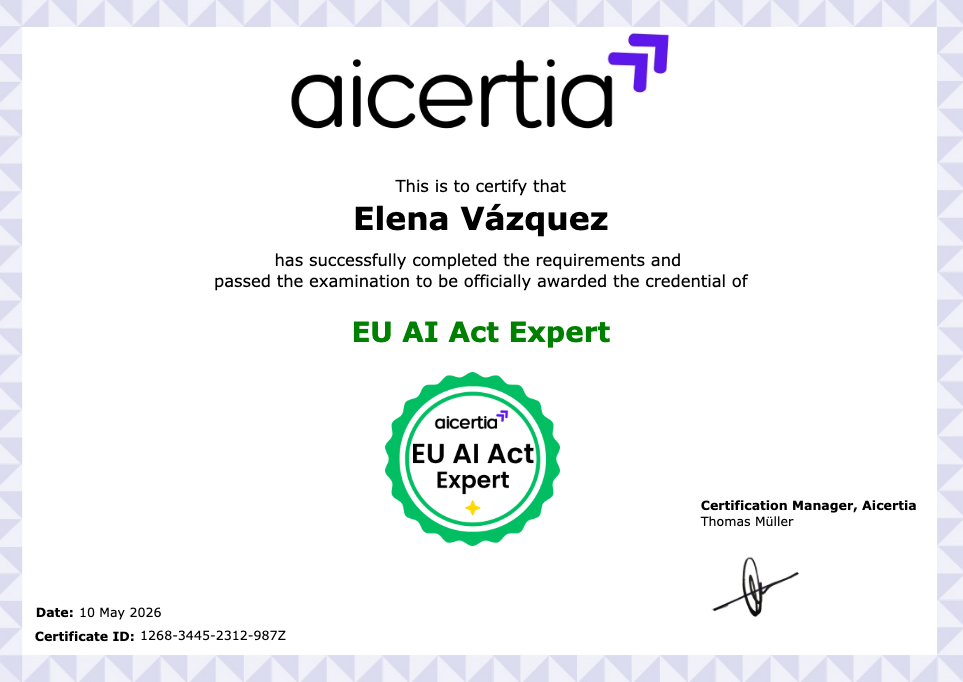
Verify the certificate’s validity using its unique ID.
Frequently Asked Questions (FAQ)
Testimonials from Our Candidates
⭐⭐⭐⭐⭐
“The Only Standard That Separates Legal Theory from Real-World Practice”
“As Head of Legal, I was looking for a credential that went beyond simply repeating the provisions of the European Regulation. Aicertia’s assessment process—particularly the preparation of the expert opinion on explainability metrics—gave me the precise tools required to structure our corporate Conformity Documentation. It is an exceptionally demanding credential.”
— Elena V., Director of Legal & Compliance at FinTech Global
⭐⭐⭐⭐⭐
“Essential for Leading Corporate AI Governance”
“As a Chief AI Officer, managing algorithmic risks is a daily responsibility. This certification has enabled me to align strict compliance with the EU AI Act seamlessly with the international ISO/IEC 42001 standard. In addition, the immutable public registry provides an immediate layer of trust for our investors and board of directors.”
— Carlos M., Chief AI Officer (CAIO) at InsurTech Solutions
⭐⭐⭐⭐⭐“A Rigorous Selection Process That Delivers Genuine Market Authority”
“What I value most about Aicertia is its independence and initial candidate screening process; this is not a credential that can simply be purchased. Completing the practical audit case study and structuring the bias-mitigation matrix presented a genuine executive-level challenge. Being included in the Global Auditor Registry has strengthened my authority before international recruitment committees.”
— Alejandro F., Technology Audit and Risk Partner at an International Consulting Firm